Press and share kit
Imago turns an API response into an interface. Paste a public API URL and it fetches the JSON in your browser and draws it as a page: the values that matter up top, a fact sheet under them, and tables and charts for the rest. It is free and open source, runs entirely in the browser with no account and no server, and works with no key; add a free Gemini or Groq key for a designed layout. Everything here is free to use when you write about or share Imago.
Fact sheet
- What
- A browser tool that draws an API’s JSON response as an interface.
- Price
- Free. No account, no sign-up.
- Licence
- MIT, open source.
- Where it runs
- Entirely in the browser. There is no Imago server: your browser calls the API, and the model provider you chose, directly.
- Models
- Optional. Bring a free Gemini or Groq key, or use none.
- Who it is for
- Developers meeting a public JSON API for the first time.
Reels
Stop reading raw JSON. Paste a URL; the JSON becomes a page on the beat. Download MP4 8.2 MB
Copied as cURL? Paste it. Headers and Basic auth come along; straight to a page. Download MP4 5.5 MB
This number is moving. Watch re-fetches and marks exactly what changed. Download MP4 8.2 MB
An AI tool that wants nothing. No account, no key needed, your key stays in your browser. Download MP4 9.6 MB
Post images
Captured from the live app. Captions are the X versions from the launch posts; posts showing the forecast credit Open-Meteo.com (CC BY 4.0).
Download PNG 30 KB
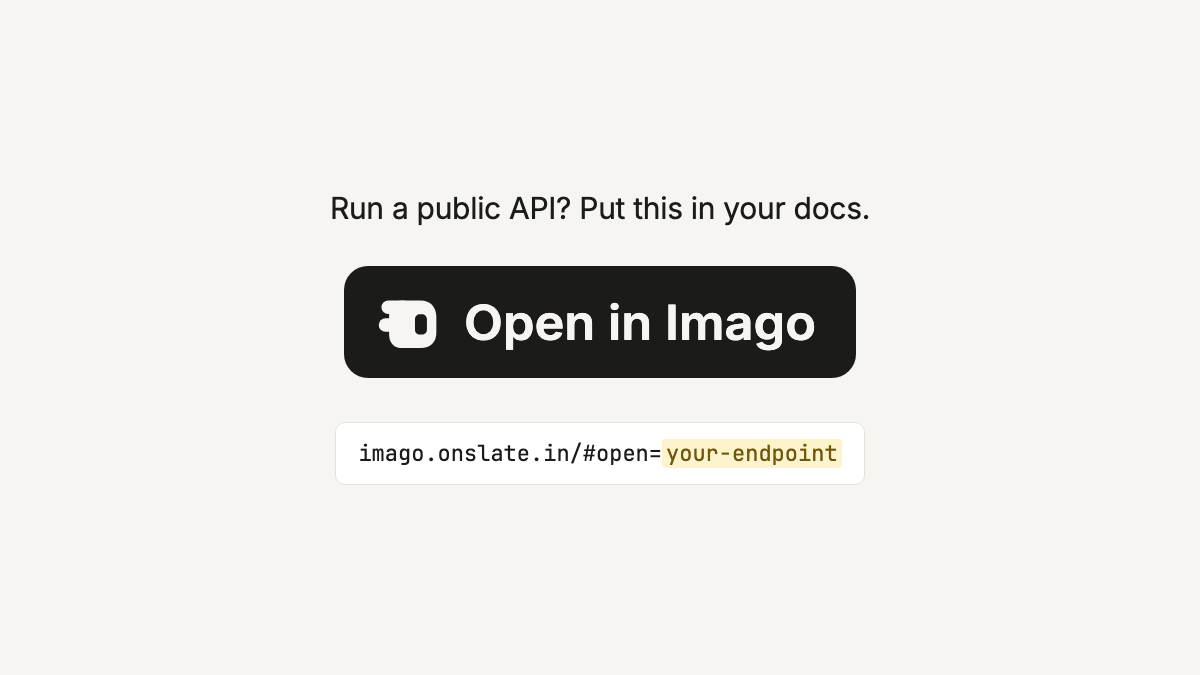
Run a public API? One line in your README gives readers an "Open in Imago" button.

imago.onslate.in/app/#open= plus your endpoint. No sign-up, no script, no server in between.

https://github.com/Sibhimanyu/imago/blob/master/launch/open-in-imago.md
Download PNG 107 KB
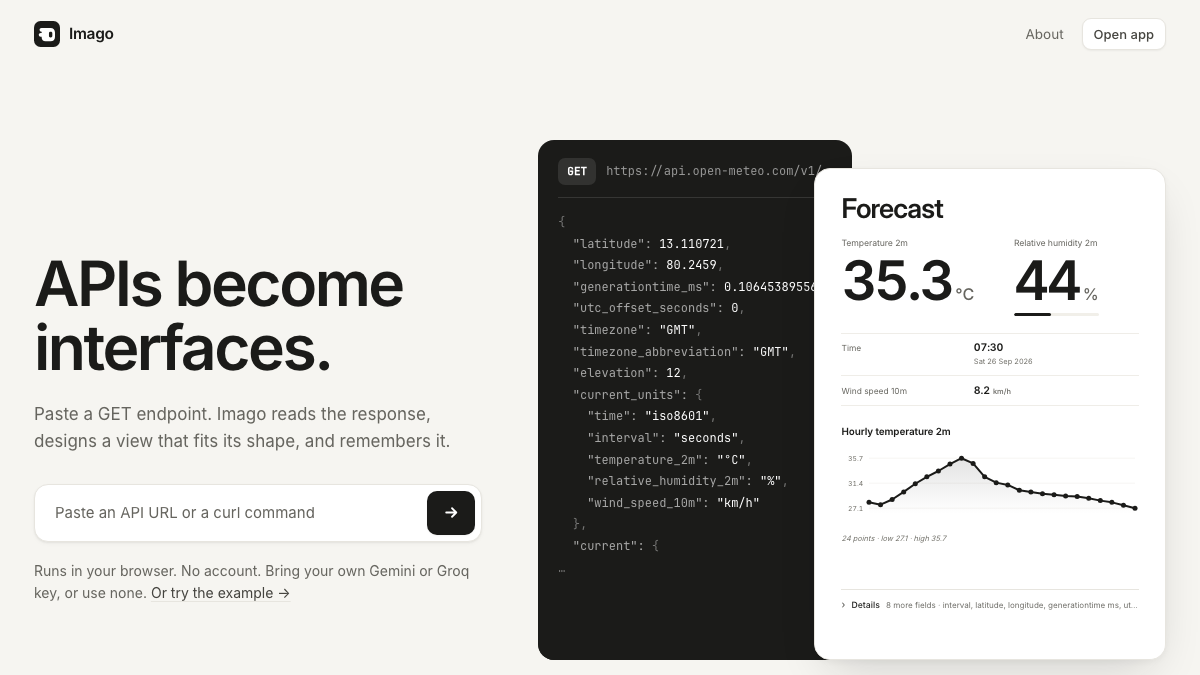
No key, no account, still works.

Without a model, Imago's renderer runs on rules that know no particular API. A test fails if a sample API's field names leak into them.

A free Gemini or Groq key gets you a designed page.

Data: Open-Meteo.com
https://imago.onslate.in
Download PNG 101 KB
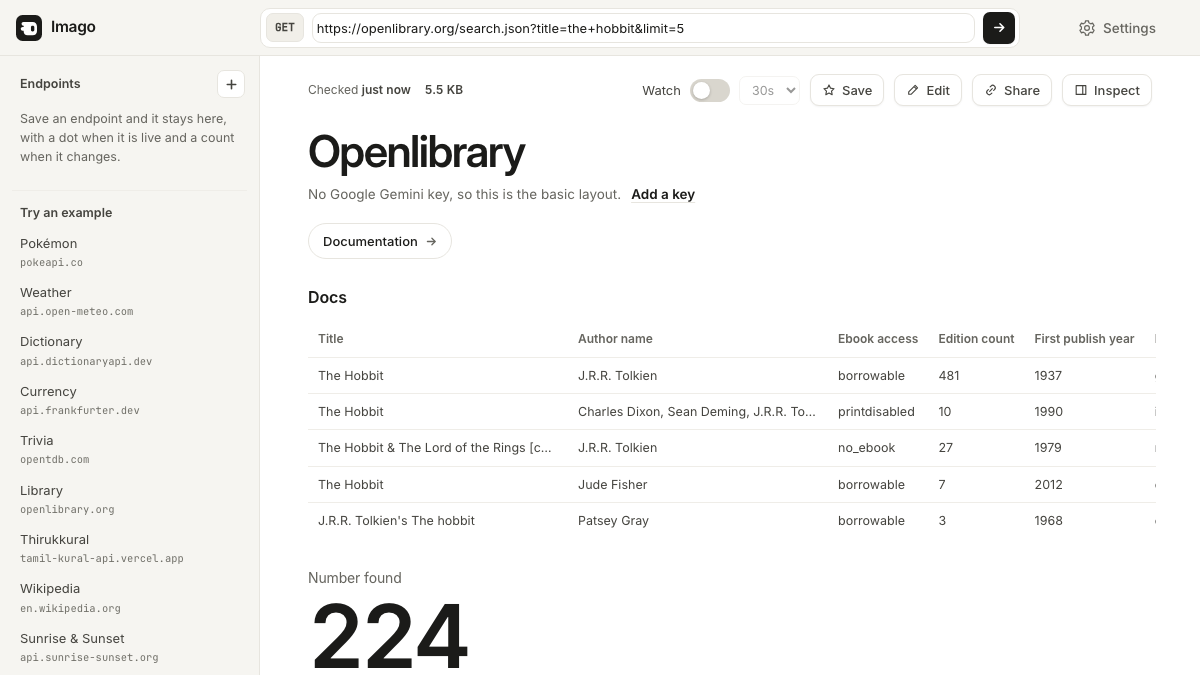
An array of objects becomes a table. Columns are picked by what tells one row from another.

Open Library, "the hobbit":
https://imago.onslate.in/app/#open=https://openlibrary.org/search.json?title=the+hobbit&limit=5
Download PNG 84 KB
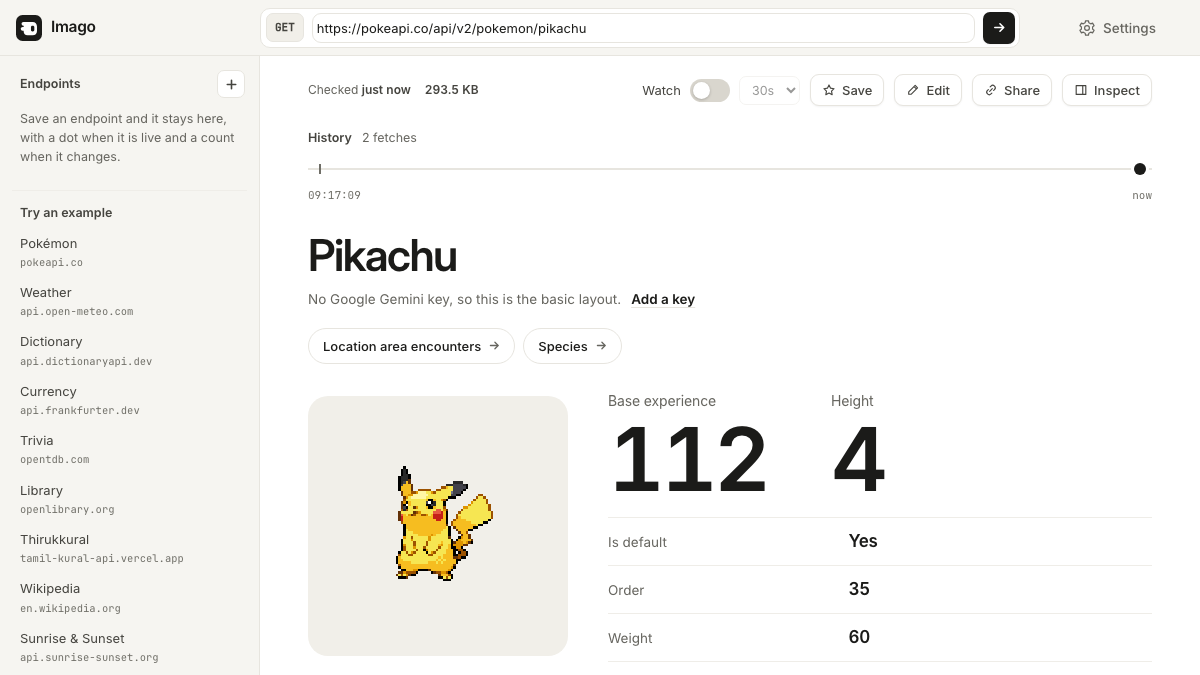
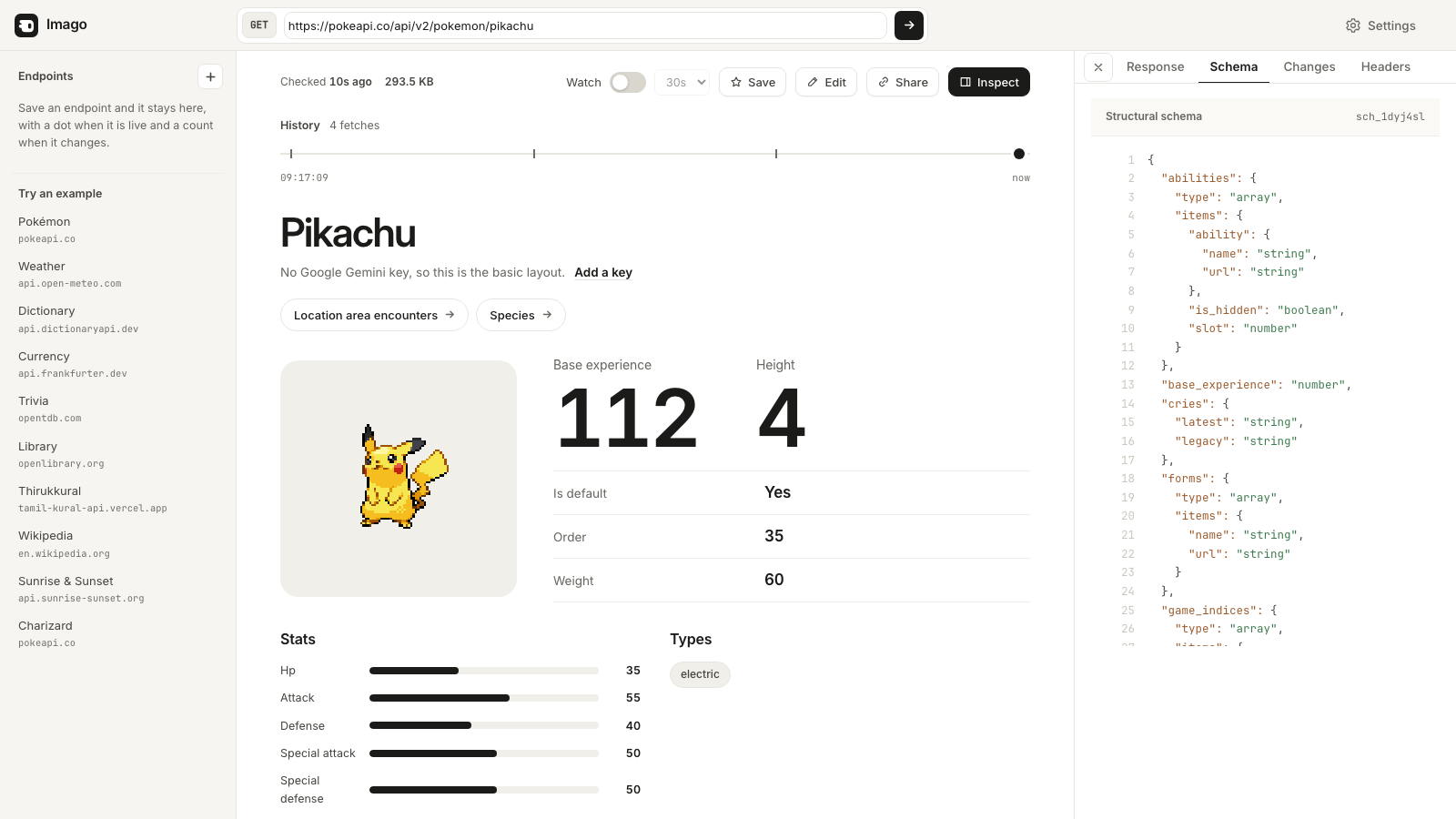
PokeAPI's Pikachu, drawn by Imago: sprite, stat bars, type badge, links as buttons.

Nobody told it what a Pokémon is. It read the shape of the JSON.

https://imago.onslate.in/app/#open=https://pokeapi.co/api/v2/pokemon/pikachu
Download PNG 148 KB
The model never writes HTML.

It gets the response's shape and returns a small JSON plan: which fields matter, which component shows each. Imago's own renderer draws it as text. Nothing from an API or a model is treated as markup.

https://github.com/Sibhimanyu/imago
Download PNG 98 KB
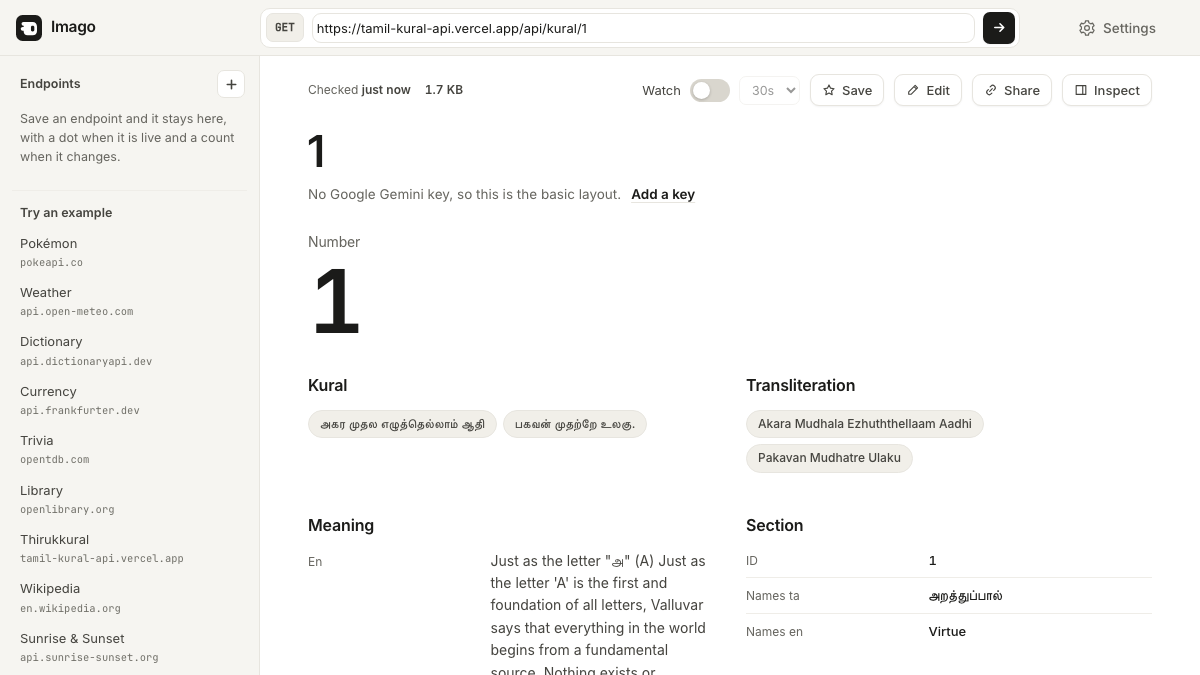
Kural 1, straight from a Thirukkural API: the Tamil verse, its transliteration and meaning, laid out from the JSON alone.

https://imago.onslate.in/app/#open=https://tamil-kural-api.vercel.app/api/kural/1
Download PNG 99 KB
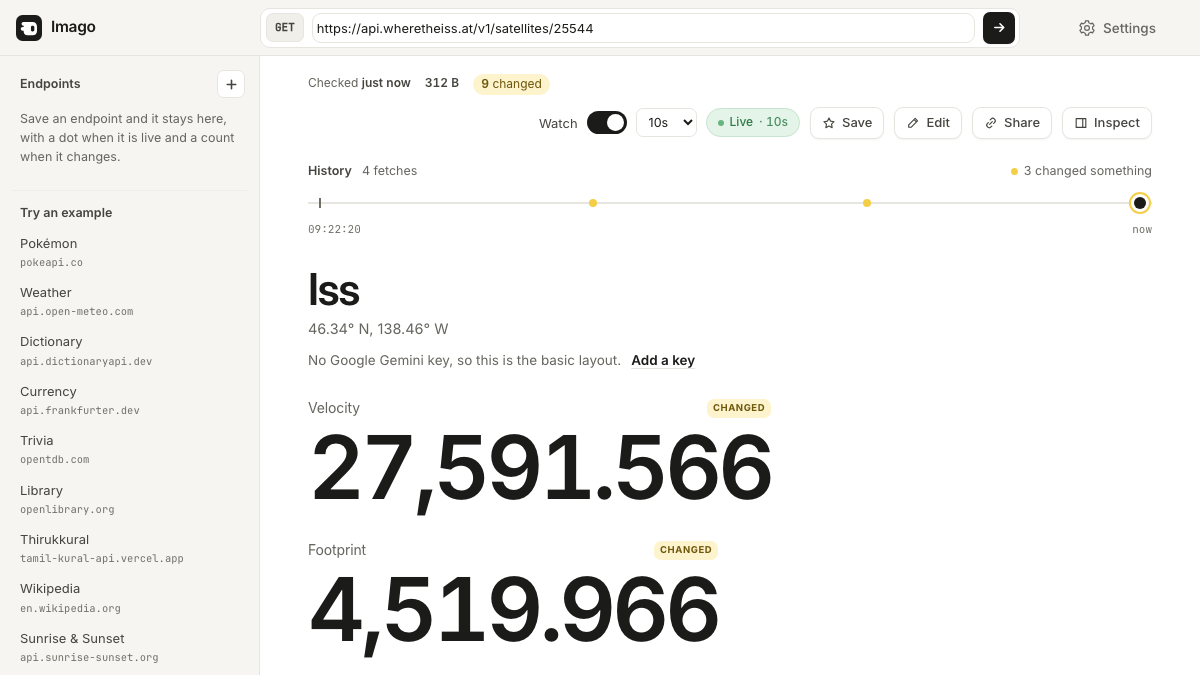
Watch re-fetches an endpoint every 10, 30 or 60s and marks exactly what changed.

Here's the ISS, watched every 10 seconds.

https://imago.onslate.in/app/#open=https://api.wheretheiss.at/v1/satellites/25544
Download PNG 99 KB
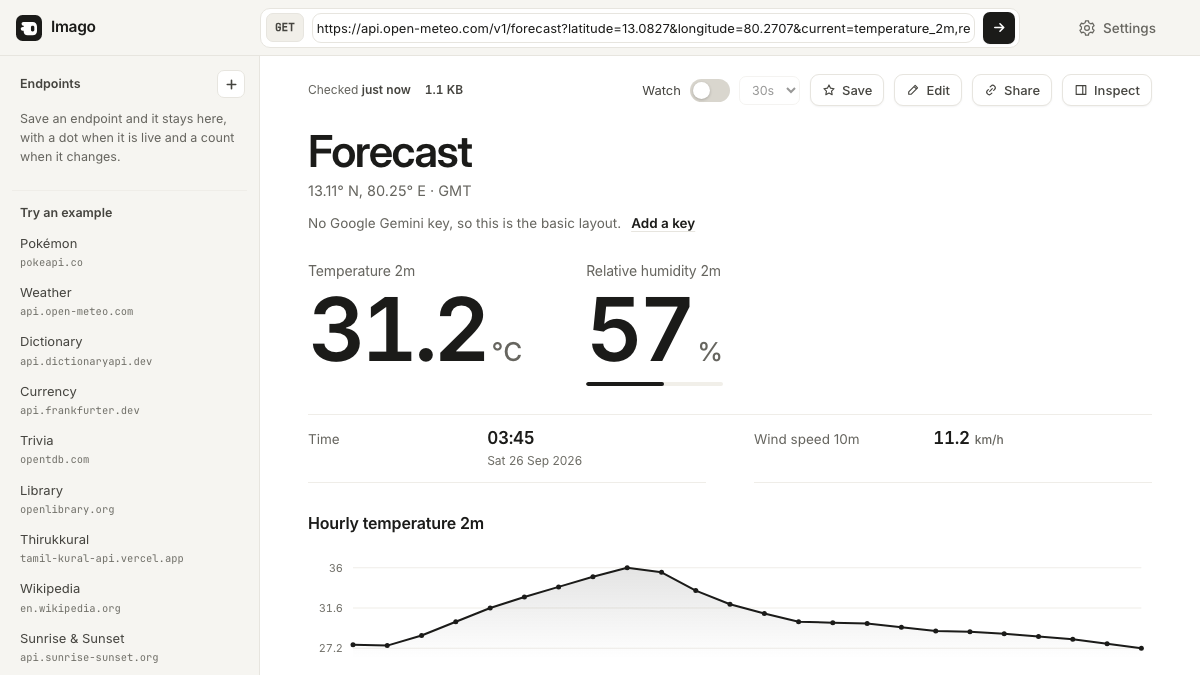
Open-Meteo puts 31.2 in one object and "°C" in another. Imago puts them back together: the temperature as the headline, humidity as a meter, the hourly forecast as a chart. Data: Open-Meteo.com https://imago.onslate.in/app/#open=https://api.open-meteo.com/v1/forecast?latitude=13.08&longitude=80.27¤t=temperature_2m,relative_humidity_2m,wind_speed_10m&hourly=temperature_2m&forecast_days=1
Brand assets
The Reveal mark: two response fields merging into one window. Ink and paper only. Amigo is the mascot.